
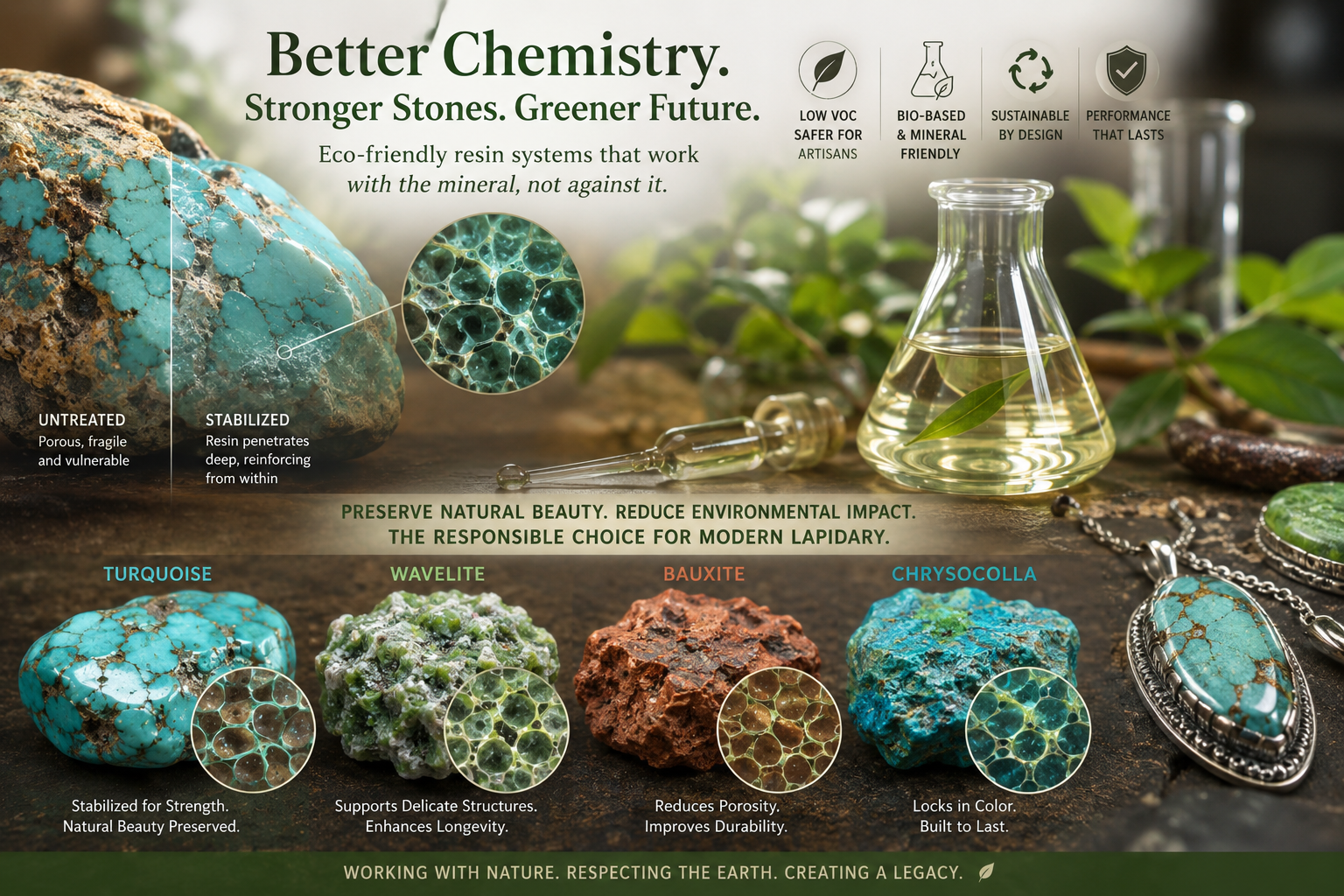
The jewelry world is built on beauty — but behind that beauty is a supply chain that has long ignored the environmental cost of the materials it relies on. Stabilizing porous stones is one of those hidden processes: essential, technical, and often overlooked. Yet the resins used in stabilization shape far more than the durability of a gemstone. They shape the environmental footprint of the entire industry.
For decades, the default stabilizers have been cheap, petroleum‑heavy, high‑VOC systems designed for mass production. They work — but they come with consequences: hazardous fumes, flammability, long‑term environmental persistence, and a chemical profile that belongs to a different era.
Eco‑friendly resin systems change that equation. They aren’t the cheapest path. They aren’t the easiest path. But they are the correct path — scientifically, ethically, and economically — for an industry that wants to survive the next decade of consumer expectations.
Sustainability Is No Longer a Luxury — It’s a Market Demand
Consumers today care about:
- Origin: where their materials come from
- Process: how they’re treated and stabilized
- Responsibility: whether the brands they support are part of the solution or part of the problem
Jewelry buyers — especially in the mid‑to‑high‑end market — increasingly ask about ethical sourcing, environmental impact, and transparency. They want stones that are stabilized without toxic additives. They want products that don’t off‑gas. They want materials that align with their values.
Eco‑friendly resin systems meet that demand directly.
Why Resin Choice Matters More Than People Realize
Stabilization isn’t just a technical step. It’s a transformation. The resin becomes part of the stone — permanently. That means the chemistry matters.
Traditional stabilizers often rely on high‑odor monomers, flammable solvents, petroleum‑derived additives, aggressive catalysts, and high‑VOC curing profiles. Eco‑friendly systems replace those with:
- High bio‑content methacrylates
- Clean‑chemical additives
- Low‑VOC curing
- Non‑MMA formulations
- Safer handling and safer work environments
This isn’t just “greenwashing.” It’s a measurable improvement in safety, environmental impact, and long‑term material performance.
The Problem With Cyanoacrylates and MMA: Fast, Cheap, and Environmentally Costly
Many stabilizers on the market rely on cyanoacrylates (CA) or methyl methacrylate (MMA) — chemistries originally engineered for speed, not sustainability. They’re popular because they cure quickly, penetrate easily, and are widely available. But those advantages come with serious drawbacks that the jewelry industry can’t ignore anymore.
High VOCs and Hazardous Fumes
Cyanoacrylates and MMA both release high levels of volatile organic compounds during curing. These vapors irritate eyes, lungs, and mucous membranes, create white film on acrylic surfaces, linger in enclosed workshops, and demand heavy PPE to use safely. If CA vapors can fog acrylic, imagine what they’re doing to your eyes and respiratory system.
Environmental Persistence
MMA and CA are petroleum‑derived monomers with long environmental half‑lives. Once they enter waste streams, they don’t break down cleanly. They contribute to air quality degradation, micro‑pollutant accumulation, and in some jurisdictions, hazardous waste classification.
Poor Long‑Term Stability Inside Porous Minerals
Cyanoacrylates cure into rigid, brittle polymers that don’t tolerate moisture, thermal cycling, steam, humidity, or bound water inside minerals. This is why CA‑stabilized turquoise often darkens, chalks, or loses hardness over time. MMA systems have similar issues: they shrink, craze, and degrade under environmental stress.
A stabilizer shouldn’t fight the mineral. It should work with it.
Not Designed for Jewelry‑Grade Mineral Treatment
Here’s the core truth the industry rarely says out loud: cyanoacrylates and MMA were never designed for stabilizing semiprecious stones. They were designed for fast repairs, industrial bonding, construction adhesives, nail salons, and medical closures — none of which involve porous minerals with hydration states, micro‑fractures, or delicate color structures.
Eco‑friendly mineral‑specific resins are designed for that.
Side‑By‑Side Comparison: CA vs MMA vs Eco‑Friendly Mineral‑Specific Resin
| Attribute | Cyanoacrylates (CA) | MMA‑Based Systems | Eco‑Friendly Mineral‑Specific Resin |
|---|---|---|---|
| Primary Design Intent | Fast repairs, general adhesives | Bulk plastics, industrial composites | Engineered specifically for porous stones |
| VOC Profile | High VOC, irritating fumes | High VOC, strong odor | Low‑VOC, cleaner curing profile |
| Worker Safety | Requires heavy PPE; eye and lung irritation common | Odor, sensitization, flammability concerns | Designed for safer handling and reduced exposure |
| Environmental Footprint | Petroleum‑derived, persistent in waste streams | Petroleum‑derived, persistent and hazardous | High bio‑content, cleaner lifecycle |
| Behavior in Porous Minerals | Brittle, prone to cracking and discoloration | Shrinkage, crazing, long‑term instability | Flexible enough to move with the stone, stable over time |
| Suitability for Jewelry‑Grade Stabilization | Compromise solution; not purpose‑built | Industrial chemistry forced into lapidary | Purpose‑built for turquoise, wavellite, bauxite, chrysocolla, and other porous stones |
| Sustainability Alignment | Poor — legacy chemistry | Poor — legacy chemistry | High — designed around sustainability and performance |
The Jewelry Industry Has a Sustainability Gap — and Resin Is One of the Easiest Places to Close It
Mining is hard to reform. Global supply chains are hard to reform. Labor practices are hard to reform. But resin? Resin is one of the simplest parts of the jewelry pipeline to modernize.
Switching to eco‑friendly stabilization:
- Reduces hazardous waste
- Improves worker safety
- Lowers environmental toxicity
- Aligns with modern consumer values
- Differentiates brands in a crowded market
It’s a small change with a big impact.
Eco‑Friendly Resin Isn’t the Cheap Path — But It’s the Right One
Sustainability requires intention. It requires investment. It requires choosing long‑term value over short‑term savings. But the payoff is real: stronger brand identity, higher consumer trust, safer workshops, cleaner environmental footprint, and better‑performing stabilized stones.
Eco‑friendly resin isn’t a trend. It’s the future of responsible mineral treatment — and the companies that adopt it now will define the next era of jewelry craftsmanship.
Closing Thought
The stones we stabilize come from the earth. The resins we use should respect that. Eco‑friendly polymer systems aren’t just a technical upgrade — they’re a statement of values. They say that beauty and responsibility can coexist, and that the jewelry industry is ready to evolve.
Leave a Reply