
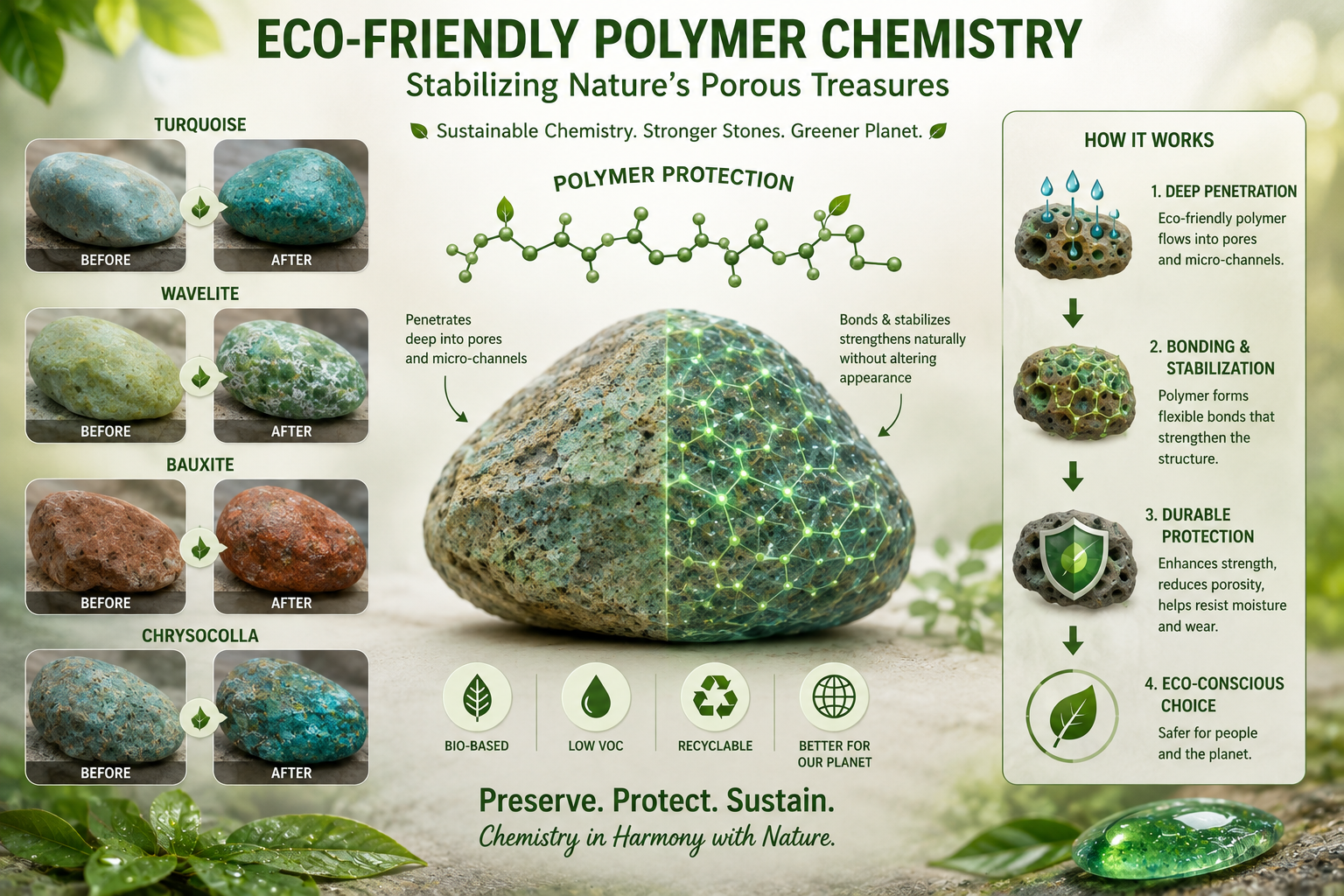
Stabilizing semiprecious minerals is not simply a craft—it is a materials science challenge. Minerals such as turquoise, wavellite, bauxite, chrysocolla, variscite, and other fragile geological materials behave very differently from wood, bone, composites, or glass. Their fracture networks, hydration states, porosity, and surface chemistry demand resin systems engineered specifically for mineral treatment.
Like many lapidaries, I began with the same lineup of products everyone else used: solvent‑thinned epoxy, cyanoacrylates, Loctite 90C, Cactus Juice, and Hyxtal. Each has strengths, but none were designed for semiprecious stones—and their limitations show it. Below is a scientific breakdown of why these products struggle, and why mineral‑specific polymer systems are the future of stabilization.
Why Minerals Are Hard to Stabilize
Minerals present unique challenges:
- Micro‑fractures and cleavage planes that wick resin unpredictably
- Variable porosity from cryptocrystalline structures to open vugs
- Hydrophilic surfaces that resist bonding with hydrophobic polymers
- Thermal sensitivity—many minerals craze or dehydrate under heat
- Bound water that interferes with polymerization
- Chemical incompatibility with common adhesives
A resin system must address all of these factors to achieve predictable penetration, strong bonding, and stable curing. Most legacy products simply were not built for this.
Comparison Tables: Legacy Stabilizers vs. Mineral‑Specific Systems
Intended Application
| Product | Evaluation |
|---|---|
| Epoxy + Acetone | Designed for composites and surface bonding, not geological substrates |
| Cyanoacrylates | Designed for fast crack repair, not bulk stabilization |
| Loctite 90C | Designed to fill porosity in cast metal engine blocks—not minerals |
| Cactus Juice | Designed for wood stabilization, not porous stone |
| Hyxtal | Designed for museum artifact surface consolidation |
| Mineral‑Specific Resin | Engineered specifically for semiprecious mineral stabilization |
Penetration
| Product | Evaluation |
|---|---|
| Epoxy + Acetone | Poor penetration; solvent thinning disrupts polymer formation |
| Cyanoacrylates | Very shallow; instant polymerization halts infiltration |
| Loctite 90C | High viscosity; not suited for mineral micro‑fractures |
| Cactus Juice | Inconsistent penetration in cryptocrystalline minerals |
| Hyxtal | High viscosity; good for surface consolidation only |
| Mineral‑Specific Resin | Custom viscosity profiles for turquoise, wavellite, bauxite, etc. |
Work Time
| Product | Evaluation |
|---|---|
| Epoxy + Acetone | Short pot life; cures before full penetration |
| Cyanoacrylates | Extremely short; seconds, not minutes |
| Loctite 90C | Fast industrial cure; incompatible with staged workflows |
| Cactus Juice | Long work time before heat cure |
| Hyxtal | Very long; excellent for surface consolidation |
| Mineral‑Specific Resin | Long work time engineered for vacuum + pressure cycles |
VOC & Safety
| Product | Evaluation |
|---|---|
| Epoxy + Acetone | High VOC; solvent exposure risks |
| Cyanoacrylates | Very high VOC; vapors polymerize on moisture, fog acrylic, irritate eyes |
| Loctite 90C | High VOC; industrial fumes |
| Cactus Juice | Low VOC; safer but high cure temperature |
| Hyxtal | Moderate VOC; requires ventilation |
| Mineral‑Specific Resin | Low VOC; engineered for safe mineral workflows |
Thermal & Environmental Stability
| Product | Evaluation |
|---|---|
| Epoxy + Acetone | Exothermic cure; unpredictable heat spikes |
| Cyanoacrylates | Poor stability—cold, steam, and water cause hydrolysis and leaching |
| Loctite 90C | Industrial thermal profile; not compatible with hydrated minerals |
| Cactus Juice | High‑temperature cure designed for wood; can dehydrate minerals |
| Hyxtal | Low‑exotherm, slow cure; safe for surface consolidation |
| Mineral‑Specific Resin | Lower‑temperature thermal cure engineered for mineral stability |
Why High‑Temperature Wood Stabilizers Fail on Minerals
Cactus Juice uses a high‑temperature cure (~90 °C) because it was engineered for wood. Wood has long, open capillaries and can tolerate high heat. Minerals cannot. Many semiprecious stones contain bound water or tight micro‑fractures that are easily damaged by high temperatures.
A lower‑temperature thermal cure—like the one used in mineral‑specific resin systems—avoids dehydration, prevents crazing, and supports controlled polymerization under vacuum and pressure.
The Hidden Dangers of Cyanoacrylates
Cyanoacrylates release extremely high VOC levels, and their vapors polymerize on contact with moisture. This is why they fog acrylic, haze lenses, and leave white film on tools. The same chemistry occurs on the surface of your eyes, which are moisture‑rich. CA vapors can cause burning, irritation, and long‑term sensitivity.
Cured CA also suffers from poor environmental stability. Cold causes contraction and micro‑cracking, steam accelerates chain scission, and excess water drives hydrolysis. This is why you can smell CA in humid conditions—the adhesive is leaching monomers as it breaks down.
The Modern Solution: Mineral‑Specific Polymer Systems
Mineral‑specific polymer systems are engineered around the physics and chemistry of geological materials. They offer:
- Long work time for deep penetration
- Controlled viscosity profiles
- Hydrophilic‑compatible bonding chemistry
- Lower‑temperature thermal curing
- Vacuum + pressure compatibility
- Low VOC for safer workflows
This is the difference between “making something work” and “engineering a system for the material.”
Final Thoughts
The lapidary world has relied on borrowed chemistry for decades. Epoxies, cyanoacrylates, wood stabilizers, and industrial adhesives were never meant for semiprecious minerals. Their limitations—penetration, work time, VOCs, thermal behavior, and bonding chemistry—are inherent to their design.
The future of mineral stabilization lies in purpose‑built polymer systems engineered around the fragility, hydration, and micro‑structure of geological materials. That is the foundation of modern mineral stabilization chemistry.
Leave a Reply